
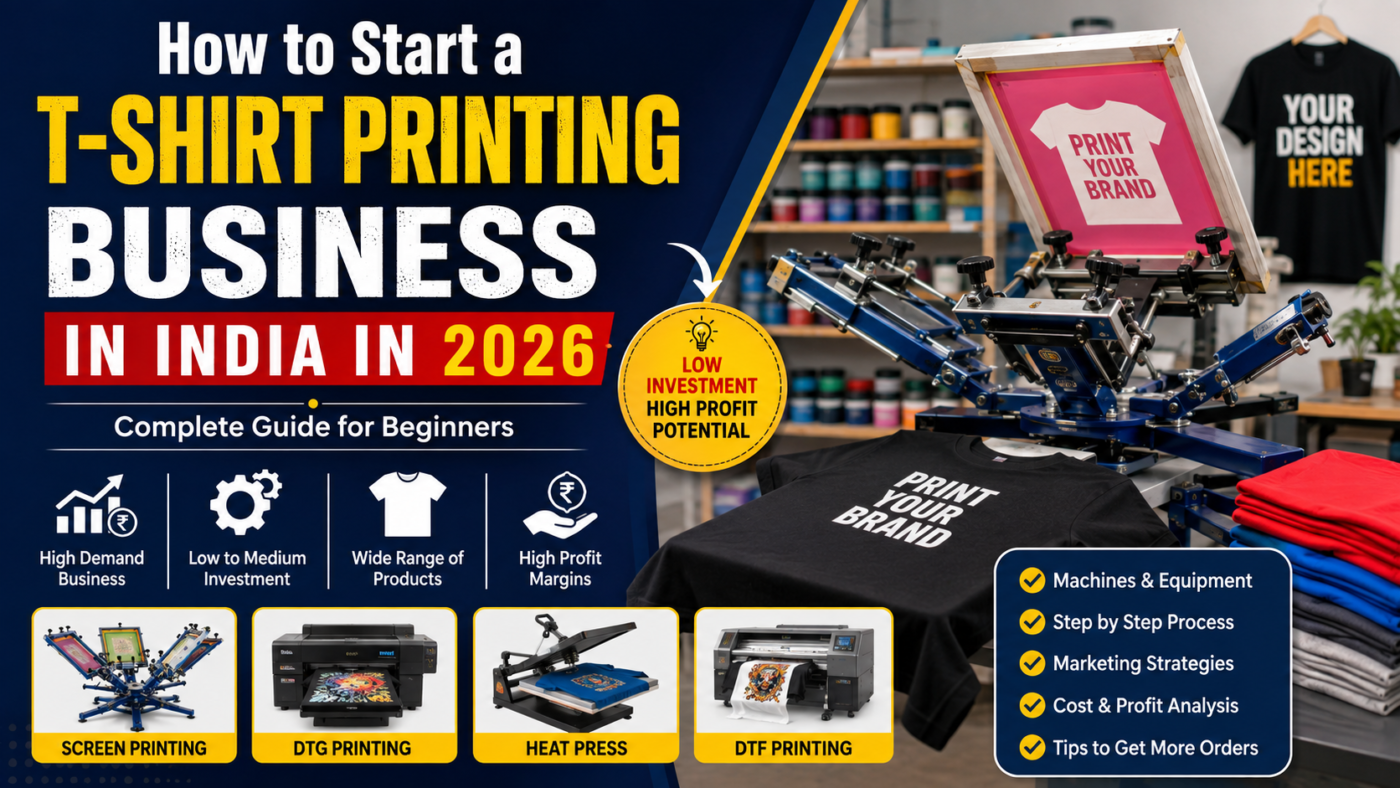
Start a T-Shirt Printing Business in India in 2026
Starting a T-shirt printing business in India can be a profitable opportunity if you choose the right printing method, understand your customers, control your costs, and build a strong sales strategy.
From custom T-shirts and college merchandise to corporate uniforms, event T-shirts, promotional clothing, and personalized apparel, the demand for printed T-shirts continues to create opportunities for small businesses and entrepreneurs.
If you are planning to start a T-shirt printing business in 2026, you may be wondering:
- Which T-shirt printing machine should I buy?
- How much does a T-shirt printing machine price cost?
- Is screen printing better than DTG or other printing methods?
- How much investment is required?
- Can I start T-shirt printing at home?
- How do I find customers?
- How profitable is a T-shirt printing business?
This guide will answer these questions and explain how you can start your own T-shirt printing business step by step.
What Is a T-Shirt Printing Business?
A T-shirt printing business involves printing designs, logos, photographs, text, or artwork onto T-shirts and other garments.
You can operate the business from a home-based workspace, a small screen printing shop, or a larger commercial production unit.
Depending on your business model, you can offer:
- Custom T-shirt printing
- Corporate T-shirt printing
- College and school T-shirts
- Event and promotional T-shirts
- Team jerseys
- Brand merchandise
- Personalized T-shirts
- Bulk wholesale printing
- Online custom T-shirt orders
The important thing is to choose a printing technology that matches your expected order volume, budget, and type of customers.
Step 1: Decide Which T-Shirt Printing Method to Use
Before buying a printing machine, understand the different printing technologies available.
The most common options include:
- Screen printing
- DTF printing
- DTG printing
- Sublimation printing
- Heat-transfer printing
- Vinyl printing
For entrepreneurs starting a business in India, screen printing remains an important option, especially for bulk orders.
Screen Printing
T-shirt screen printing uses a mesh screen, stencil, ink, and a printing press to transfer a design onto fabric.
It is particularly suitable for larger quantities because the cost per T-shirt can become lower as the order quantity increases.
A basic setup may include:
- Screen printing press
- Screens
- Squeegees
- Screen printing inks
- Emulsion
- Exposure unit
- Drying equipment
- Cleaning and reclaiming equipment
- Flash curing equipment
- Registration equipment
A manual screen printing press can be a practical starting point for a small business.
Advantages of Screen Printing
- Suitable for bulk orders
- Durable prints
- Wide range of inks and effects
- Good for cotton garments
- Can produce vibrant prints
- Relatively low production cost for larger quantities
- Can be started on a small scale
If you plan to print hundreds or thousands of similar T-shirts, screen printing can be an excellent production method.
Step 2: Understand Different T-Shirt Printing Machines
One of the biggest mistakes beginners make is searching only for the best T-shirt printing machine without first deciding what type of printing they want to offer.
There is no single machine that is best for every business.
For example, a beginner interested in screen printing may need a t shirt screen printing machine, while someone producing full-color individual designs may consider a DTG or DTF system.
Screen Printing Machine
A screen printing machine is designed specifically for screen printing garments and other materials.
Depending on the design, you can find:
- Manual screen printing machines
- Semi-automatic screen printing machines
- Automatic screen printing machines
For a small business, screen printing machines for small business can be a more affordable starting point than a large automatic production system.
Automatic Screen Printing Machine
An automatic screen printing machine can increase production speed and consistency.
However, automatic equipment generally requires a considerably larger investment and is more suitable for businesses receiving high-volume orders.
Beginners should not automatically choose an automatic machine simply because it is faster.
Your machine should match your actual production requirements.
Step 3: Calculate Your T-Shirt Printing Business Investment
The investment required depends heavily on the printing method and production capacity.
A small screen printing setup may require investment in:
- Printing press
- Screens
- Squeegees
- Exposure equipment
- Inks
- Emulsion
- Cleaning chemicals
- Drying equipment
- Work tables
- Blank T-shirts
- Packaging materials
You also need to consider:
- Rent
- Electricity
- Labour
- Marketing
- Website expenses
- Packaging
- Delivery
- Raw materials
Instead of asking only about the screen printing machine price, calculate the cost of your complete production setup.
For example, buying a low-cost machine but having insufficient working space, poor exposure equipment, or inadequate curing equipment can create production problems.
Step 4: Choose the Right Screen Printing Equipment
Your screen printing equipment plays an important role in the quality and consistency of your finished products.
A basic setup can include:
1. Screen Printing Press
The press holds the garment and screen in position while printing.
For beginners, a manual press can be easier to learn and operate.
2. Screens
Screens are used to transfer the design onto the garment.
The number of screens required depends on the number of colours in the design.
3. Squeegee
A squeegee is used to push ink through the mesh and onto the T-shirt.
4. Exposure Unit
An exposure unit is used to create the stencil on the screen.
5. Inks
Different types of inks can be used depending on the fabric, design and desired finish.
6. Curing Equipment
Proper curing is essential for print durability.
7. Screen Reclaiming Equipment
After printing, screens can be cleaned and prepared for future designs.
Investing in suitable screen printing equipment can improve print quality and reduce production problems.
Step 5: Learn T-Shirt Screen Printing Properly
Buying a shirt printing machine is only one part of the business.
You also need to understand the printing process.
A typical screen printing workflow involves:
- Creating the artwork
- Preparing the screen
- Applying emulsion
- Drying the coated screen
- Exposing the design
- Washing out the stencil
- Setting up the screen
- Registering the design
- Applying ink
- Flash curing when required
- Final curing
- Quality inspection
- Packing the finished T-shirts
Beginners should learn these steps before accepting large commercial orders.
A poor stencil, incorrect exposure, improper ink deposit, or insufficient curing can result in rejected garments and wasted materials.
Step 6: Decide Whether to Start at Home or Open a Shop
You don’t necessarily need a large commercial space to begin.
T-shirt printing at home can be possible if you have enough space for your equipment, ventilation, storage, washing and drying processes.
A home-based setup can help reduce:
- Rent
- Initial overhead
- Operating costs
However, you should make sure your workspace is suitable for the equipment and production process.
If you expect high-volume orders, you may eventually need a dedicated screen printing shop or production unit.
Step 7: Choose Your Target Customers
Don’t try to sell T-shirts to everyone.
Choose specific customer groups.
Potential customers include:
Colleges and Students
College festivals, clubs, trips and student organizations frequently require customized T-shirts.
Businesses
Companies may require branded T-shirts for employees, promotional campaigns and events.
Events
Birthday parties, marathons, exhibitions, festivals and other events can generate bulk orders.
Sports Teams
Local sports teams and academies may require customized jerseys and T-shirts.
Clothing Brands
You can provide custom screen printing services to small clothing brands that don’t have their own production facilities.
Local Entrepreneurs
New clothing businesses may need a reliable printing partner for small and medium-sized orders.
Step 8: Start With a Profitable Product Strategy
Don’t compete only on price.
Instead, create different packages.
For example:
Basic Package
Simple one-colour screen printing for bulk orders.
Premium Package
Multi-colour printing with higher-quality garments.
Custom Package
Individualized designs for events, businesses and brands.
You can also offer different garment options such as:
- Regular T-shirts
- Oversized T-shirts
- Polo T-shirts
- Hoodies
- Sweatshirts
- Sportswear
This allows you to serve different customer segments.
Step 9: Understand Bulk and Wholesale Screen Printing
One of the major advantages of screen printing is its suitability for bulk production.
If a customer orders 10 T-shirts, the setup cost can represent a significant part of the total order.
With 100, 500 or 1,000 similar T-shirts, the setup cost can be distributed across more garments.
This is why wholesale screen printing and bulk custom T-shirt orders can be attractive business opportunities.
Before accepting an order, calculate:
Blank T-shirt cost + printing cost + labour + packaging + wastage + delivery + overhead + profit = Selling price
Never calculate your selling price based only on the cost of the blank T-shirt.
Step 10: Compare Screen Printing With DTG Printing
Another technology you may come across is direct to garment, commonly known as DTG.
A DTG printing machine prints directly onto the garment using specialized textile ink.
DTG can be useful for:
- Detailed artwork
- Photographic designs
- Individual orders
- Small quantities
- Multiple-colour designs
However, a DTG printer price can be considerably higher than a basic manual screen printing setup.
Screen printing can therefore be attractive for entrepreneurs who want to focus on bulk orders and traditional garment printing.
The best technology depends on your business model.
Step 11: Build a Strong T-Shirt Printing Brand
Your equipment does not create the brand.
Your customer experience does.
Create a professional brand identity with:
- Business name
- Logo
- Website
- Social media pages
- Product catalogue
- Sample T-shirts
- Customer testimonials
- Professional photographs
- WhatsApp Business profile
Show customers exactly what you can print.
Create samples for different applications such as:
- Corporate T-shirts
- College T-shirts
- Oversized T-shirts
- Event T-shirts
- Brand merchandise
- Sports T-shirts
Step 12: Get Customers for Your T-Shirt Printing Business
Getting customers is just as important as learning printing.
Start with your local market.
You can approach:
- Colleges
- Gyms
- Schools
- Restaurants
- Startups
- Local businesses
- Event organizers
- Sports clubs
- Clothing brands
You can also promote your services through:
- YouTube
- Google Business Profile
- Local SEO
- Paid advertising
If someone searches for screen printing near me, custom screen printing near me, or screen print shops near me, having a strong local online presence can help potential customers discover your business.
Step 13: Create a Portfolio Before Spending Heavily on Advertising
Before running advertisements, create a portfolio.
Print different designs and photograph them professionally.
Your portfolio should demonstrate:
- Print quality
- Colour accuracy
- Different garment types
- Different print sizes
- One-colour printing
- Multi-colour printing
- Large designs
- Small logos
- Special effects
Customers want to see your work before placing an order.
Step 14: Avoid These Common Beginner Mistakes
Many new T-shirt printing businesses struggle because they focus too much on buying equipment and not enough on the business side.
Avoid these mistakes:
Buying Equipment Without Learning
A machine cannot replace printing knowledge.
Buying More Capacity Than You Need
Don’t purchase a large automatic screen printing machine when you don’t yet have enough orders to justify it.
Ignoring Curing
Poor curing can cause prints to crack, peel or wash out.
Underpricing
Cheap prices can destroy your margins.
No Quality Control
Every order should be checked before delivery.
Depending on One Customer
Build multiple customer sources.
Ignoring Marketing
Even the best T-shirt printer will not generate sales without customers.
How Much Can You Earn From a T-Shirt Printing Business?
Your income depends on:
- Number of orders
- Average order value
- Printing cost
- T-shirt cost
- Labour
- Rent
- Marketing expenses
- Production efficiency
- Customer type
For example, a business focusing on individual custom orders will have a different profit structure from a company specializing in wholesale screen printing.
Instead of focusing only on how much you can earn per T-shirt, focus on building a repeatable system that generates regular orders.
Is T-Shirt Printing a Good Business in India in 2026?
Yes, it can be a good business opportunity for entrepreneurs who approach it as a complete business rather than simply buying a machine.
The biggest opportunity is not necessarily in selling one printed T-shirt at a time.
You can build multiple revenue streams through:
- Bulk T-shirt printing
- Corporate orders
- College orders
- Event orders
- Clothing brands
- Custom merchandise
- Wholesale printing
- Online orders
- Printing services for other businesses
The right combination of production skills, marketing and customer acquisition can make the business much more sustainable.
Final Thoughts
Starting a T-shirt printing business in India in 2026 doesn’t require you to immediately invest in the most expensive T-shirt printing machine or screen printing machine.
Start by understanding your market.
Then choose the printing method according to your customers and expected order volume.
If you want to focus on bulk orders, screen printing can be an excellent technology to learn. A properly planned setup with the right screen printing equipment, quality materials and good printing skills can help you build a professional garment printing business.
Most importantly, learn the complete process before investing heavily in equipment.
Learn the skill. Start small. Get customers. Improve your production. Then scale.
If you’re serious about starting a T-shirt printing business, learning professional T-shirt screen printing can help you avoid costly beginner mistakes and build a stronger foundation for your business.
Frequently Asked Questions
1. Which is the best T-shirt printing machine for a small business?
There is no single best machine for every business. For a beginner focusing on bulk orders, a manual screen printing setup can be a practical starting point. Your choice should depend on order volume, budget, available space and printing requirements.
2. What is the T-shirt printing machine price in India?
The price varies significantly depending on the technology, production capacity and manufacturer. A manual screen printing setup can cost much less than a commercial automatic system or a digital garment printer. Always calculate the cost of the complete setup rather than looking only at the machine price.
3. Can I start T-shirt printing at home?
Yes, a small T-shirt printing at home business can be possible if you have adequate workspace and suitable equipment. Screen printing requires space for preparation, printing, drying, curing and cleaning.
4. Is screen printing profitable?
Screen printing can be profitable, particularly for bulk orders where setup costs can be distributed across many garments. Profitability depends on your pricing, material costs, production efficiency and ability to acquire customers.
5. Should I buy an automatic screen printing machine?
Not necessarily. If you’re starting with small or medium order volumes, a manual setup may be sufficient. An automatic machine becomes more relevant when your production requirements justify the additional investment.
6. Is DTG better than screen printing?
Neither technology is universally better. DTG can be useful for detailed designs and smaller quantities, while screen printing is often well suited to bulk orders. Choose based on your target customers and production requirements.
7. Can I start a T-shirt printing business with a small investment?
Yes. You can start with a smaller setup and gradually expand as your customer base grows. The key is to avoid investing in unnecessary equipment before you have sufficient demand.
8. How do I get T-shirt printing customers?
Start by targeting local businesses, colleges, gyms, events, sports teams and clothing brands. Build a portfolio, promote your work online, use WhatsApp and social media, and develop a local presence so customers searching for printing services can find you.
Add a Comment